
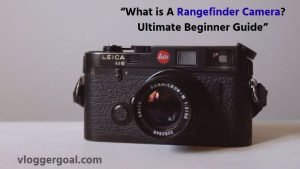
Picture yourself walking down a bustling city sidewalk with a camera hanging around your neck. You are searching for the perfect, unscripted photograph that captures the essence of urban life. However, you are holding a rangefinder camera, not just any old camera.
This isn’t your typical DSLR or point-and-shoot camera. The rangefinder is a unique piece of photographic history that has successfully carved out a niche for itself. What is the significance of rangefinder cameras, then? Why do some photographers adore them despite the availability of modern high-tech equipment?
We’ll explore the wonders of rangefinder cameras in this essay. We’ll look at how they work, why many professionals and enthusiasts use them, and how utilizing one could up your photography game to a whole new level of enjoyment and complexity.
Stay with me as we explore the world of rangefinders and see how they might enhance your photographic endeavors!
What is a rangefinder camera?
A rangefinder camera is a type of camera that uses a range-finding focusing mechanism rather than a through-the-lens viewing system like SLRs or DSLRs. In simple terms, you don’t look through the lens when composing your shot, you look through a separate optical viewfinder that’s coupled to a rangefinder mechanism to measure focus distance.
The defining characteristic is the rangefinder focusing system, which allows photographers to measure subject distance and achieve precise manual focus.
How Does a Rangefinder Work
Viewfinder Window: Located on the camera body, this is the window you look through to compose your shot. It does not show exactly what the lens sees, but an approximate framing.
Rangefinder Mechanism: Next to the main viewfinder is a secondary window. Light enters here and is directed by a small mirror or prism. In the viewfinder, you’ll see a superimposed image.
Focusing Process: When you turn the focusing ring on the lens, the rangefinder mechanism moves the secondary image. Align the two images into one. The subject is in focus when they perfectly overlap.
Lens Mount Coupling: Rangefinder lenses are mechanically coupled with the rangefinder mechanism. Turning the focus ring physically moves a cam that communicates with the camera body’s rangefinder system.
Advantages of Rangefinder Cameras
- Compact & Quiet: No mirror slap, so very discreet.
- Excellent Image Quality: Rangefinder lenses can be smaller and sharper because they don’t need to clear a mirror box.
- Bright Viewfinder: You can see outside the frame lines, helpful for anticipating subjects entering the frame.
- Low-Light Focusing: Rangefinder focusing patches often remain visible in dim conditions.
- Less Vibration: No mirror movement reduces camera shake at slower shutter speeds.
Disadvantages of Rangefinder Cameras
- Parallax Error: Since the viewfinder is offset from the lens, close-up framing can be inaccurate.
- Limited Lens Range: Most rangefinder systems max out around 135 mm; telephoto and macro are tricky.
- No Through-the-Lens View: You can’t preview depth of field, filters, or exact framing.
- Learning Curve: Manual focus only, and rangefinder alignment must be precise.
History & Notable Models
- Early Rangefinders (1920s–30s): Leica I (1925) pioneered 35 mm still photography with rangefinder focusing.
- Golden Era (1950s–70s): The Leica M3 (1954), Canon P, Nikon S2, and many Soviet Gorki/FED cameras defined the classic rangefinder look.
- Modern Digital Rangefinders: The Leica M series continues the tradition with digital sensors but the same optical focusing mechanism.
- Other Systems: Some compact film cameras also used rangefinders.
Who Uses Rangefinders?
- Street Photographers: Discreet, fast, quiet.
- Documentary Photographers: Compact and reliable for candid work.
- Film Enthusiasts: Love the tactile, manual focusing experience.
- Leica Collectors: Rangefinders, especially Leica, hold cult-like status.
A rangefinder camera is a manual-focus camera system where focusing is achieved by aligning two superimposed images in a viewfinder. They’re legendary for their compact size, quiet operation, sharp lenses, and use in street/documentary photography, though less practical for telephoto or macro work.
How Does a Rangefinder Camera Work?
A rangefinder camera measures the distance between the camera and the thing being photographed using a system of mirrors and lenses. Once two shots of the subject are precisely aligned, the photographer looks through the viewfinder and adjusts the focus. A focusing mechanism is moved until the two images line up in order to do this.
The photographer can then set the proper focus distance by reading the distance between the subject and the camera from a scale on the lens barrel. Rangefinder cameras are renowned for their ability to focus precisely, operate quietly, and be small. Some photographers still use them now; they were popular in the middle of the 20th century.
Optical Mechanism
The camera has two separate windows: the main viewfinder and a smaller, offset window (the rangefinder window). Light from the rangefinder window is redirected and superimposed onto the center of the main view via internal mirrors or prisms, creating the focusing patch.
Focusing System
The photographer adjusts the lens focus ring, which is mechanically coupled to the internal rangefinder mirror/prism. This adjustment causes the image within the focusing patch to move.
Distance Measurement
When the two images within the central patch are perfectly aligned and merge (coincide), the subject is in sharp focus. This action utilizes the geometric principle of triangulation (based on the fixed distance between the two windows) to precisely set the lens’s focal distance.
Viewfinder Display
The photographer sees the scene clearly, along with superimposed bright lines that frame the actual area the lens will capture. These frame lines automatically shift slightly as the focus distance changes to correct for parallax error.
What Does a Rangefinder Camera Do?
A rangefinder camera is not just a device that captures images; it facilitates a specific, contemplative, and highly precise style of manual photography. Its design choices dictate a unique set of capabilities and limitations compared to other camera types.
1. Optical Rangefinder
The core function of the rangefinder camera is to accurately and quickly determine the distance to a subject using optics rather than electronics.
Triangulation: The camera’s main function is to perform optical triangulation. It uses two separate entry points for light that are set apart by a fixed distance. This fixed base and the variable angle of light required to align the two images are used to calculate the precise subject distance.
Focus Confirmation: The camera provides a clear, visual cue for focus: the perfect coincidence or fusion of the two images within the central patch. This physical alignment task requires the photographer to actively participate in the process, ensuring a high degree of control and focus accuracy, particularly with fast prime lenses.
Aids Manual Focus: Unlike modern autofocus systems that select focus points, the optical rangefinder’s primary role is to act as a superb, dedicated tool for entirely manual focus, forcing the photographer to engage with distance and depth of field.
2. Focusing Mechanism
The rangefinder camera’s mechanisms are designed to prioritize speed and tactile control during focusing.
Mechanical Coupling: The camera body’s focusing mechanism is mechanically coupled to the lens focus ring. This means every slight adjustment of the focus ring results in a precise, corresponding movement of the internal rangefinder prism. This direct physical link eliminates electronic lag and provides immediate feedback.
Shorter Focus Throw: Rangefinder lenses are often designed with a shorter “focus throw” compared to SLR lenses. This is a design choice that facilitates faster focusing and makes techniques like zone focusing highly effective, which is crucial for quick-reaction photography like street shooting.
Shutter Release Stability: By eliminating the large, rapidly moving mirror of an SLR, the rangefinder camera effectively minimizes vibration when the shutter is pressed. This allows the camera to consistently achieve sharper results when shooting handheld at slower shutter speeds.
3. Parallax Correction
A critical role of the rangefinder system is to mitigate its main design flaw, parallax error, to ensure accurate composition.
Viewfinder vs. Lens Perspective: Because the viewfinder is offset from the taking lens, the photographer’s line of sight is slightly different from the lens’s line of sight. The camera’s job is to adjust for this difference.
Automatic Frame Line Compensation: The camera automatically shifts the internal projected bright lines as the lens is focused closer. This dynamic movement ensures that the area enclosed by the frame lines matches the area captured by the lens, which is particularly important when shooting portraits or close subjects where the error would be most visible.
Off-Frame Viewing: The design facilitates the function of seeing outside the captured frame. The main viewfinder is typically wider than the frame lines, allowing the photographer to observe subjects entering the scene, helping them anticipate action and time their shots perfectly.
4. Compact Design
The structure of the rangefinder camera allows it to perform the function of providing maximum capability in the smallest possible form.
Elimination of the Mirror Box: By getting rid of the bulky mirror box, the camera body’s depth is significantly reduced. This makes the camera much more portable and discreet than an equivalent full-frame SLR.
Enhanced Discretion: The combination of smaller size and a very quiet shutter makes the rangefinder camera perfect for candid and documentary photography. The photographer is less intrusive, resulting in more natural and unposed images.
Unique Lens Formats: The short distance from the lens to the film/sensor plane allows for unique, smaller lens designs. The camera thus functions as a platform for extremely high-quality optics that are structurally more compact than their SLR counterparts.
Benefits Of A Rangefinder Camera
A rangefinder has many advantages. The list is endless and includes the experience, simplicity, concentration, and feel. This is not to imply that a rangefinder is inferior to an SLR or a mirrorless digital camera. Every kind of camera has benefits, and the rangefinder is a great choice for vintage or mechanical photographers.
1. Accurate Focus
The rangefinder system offers a unique and highly reliable method for achieving critical manual focus, particularly advantageous over older SLR systems.
Triangulation Principle: The mechanism is based on the geometric principle of triangulation. The photographer aligns two displaced images into a single, cohesive image within the central focusing patch.
Precision in Low Light: The human eye is excellent at discerning the perfect alignment of lines and edges, even in low-contrast or dim lighting conditions. This allows for more precise manual focus than trying to judge sharpness on a dim focusing screen.
Coupled Mechanism: Since the focus patch is mechanically linked to the lens focus helical, when the images are perfectly aligned in the viewfinder, the lens is simultaneously set to the exact distance of the subject, ensuring sharpness.
2. Rapid Focus
While initially requiring practice, the design allows experienced users to achieve focus exceptionally quickly.
Short Focus Throw & Tab: Many rangefinder lenses feature a short focus throw and a characteristic focus tab or finger rest. This allows the photographer to focus instantly by feel and muscle memory, quickly pushing the tab to the required distance without even having to look at the distance scale.
Zone Focusing: The combination of a clear distance scale and accurate rangefinder mechanism facilitates zone focusing. The photographer pre-sets the lens to a specific distance and aperture to ensure everything within a certain zone is sharp.
3. Seeing Beyond the Frame
The rangefinder’s optical viewfinder provides a viewing experience that fundamentally differs from looking through the lens.
Peripheral Vision Advantage: The optical viewfinder shows a field of view that is significantly wider than what the lens will actually capture. The actual composition boundaries are shown by bright-line frame lines overlaid on the scene.
Anticipation and Context: This ability to see the space outside the final photograph allows the photographer to anticipate action, such as a person or object about to enter the frame, and time the shot perfectly. It also helps the photographer understand the broader context of the scene.
Non-Dimming View: Unlike an SLR, where the viewfinder darkens when the lens is stopped down, the rangefinder view is always bright and clear, regardless of the aperture.
4. No Mirror
The absence of a complex, moving mirror-box assembly is the single greatest structural differentiator and the source of several other benefits.
Reduced Camera Shake: The loud clack of an SLR mirror flipping up creates internal vibration that can cause blurring at critical slower shutter speeds. By eliminating the mirror, the rangefinder allows for sharper handheld images at much slower shutter speeds.
Quiet Operation: The only sound a classic rangefinder makes is the soft snick of the shutter itself. This extremely quiet and discreet operation is highly valued for candid street photography, documentary work, or shooting in quiet environments like churches or theaters.
No Viewfinder Blackout: The viewfinder remains active and bright throughout the exposure, allowing the photographer to see the subject at the moment of capture, preventing them from missing the “decisive moment.”
5. Prime Lenses
The mirrorless nature of the design enables lens manufacturers to create specialized, high-performing lenses.
Shorter Flange Distance: Since there is no mirror to clear, rangefinder lenses have a shorter flange-to-focal distance.
Optimal Wide-Angle Design: This freedom allows optical engineers to design wide-angle lenses where the rear element can sit closer to the film plane. This results in wide-angle optics that are often smaller, lighter, and possess superior corner-to-corner sharpness and lower distortion compared to their retrofocus SLR equivalents.
6. Compact and Reliable
The simplicity of the core design contributes to its practical advantages.
Portability: The lack of a bulky mirror and prism assembly makes rangefinder bodies significantly smaller and more compact than SLRs. This, combined with smaller prime lenses, makes them ideal for travel, discretion, and all-day carrying.
Mechanical Reliability: Classic film rangefinders are predominantly mechanical devices. With fewer moving parts than a complex SLR, they are typically known for their robustness and longevity, requiring less electronic maintenance and operating reliably even in extreme temperatures or without battery power.
7. Different Shooting Experience
Using a rangefinder encourages a more deliberate, thoughtful, and connected approach to photography.
Pre-Visualization: Because you are not seeing the exact depth of field through the lens, the photographer is forced to pre-visualize the final image, thinking consciously about distance, DOF, and aperture settings rather than relying solely on visual feedback. This process enhances photographic skill.
Intimate Connection: The compact size and quiet nature of the camera, combined with the wider view, allow the photographer to feel less separated from the subject. The camera becomes an extension of the eye, encouraging a more natural and intimate interaction with the scene.
Manual Control Focus: The necessity of manual focus and manual exposure control reinforces an understanding of the fundamental exposure triangle.
Drawbacks of Rangefinder Cameras
Unfortunately, no camera type is flawless, which is why having or practicing with a variety is enjoyable and prudent. Of course, rangefinders aren’t for everyone. They can be annoying. They have limitations, just like any other tool. Without a doubt, rangefinders can limit your photography. How?
Parallax Error
A rangefinder’s viewfinder window is located next to and above the lens. You don’t receive what you see. This implies that you may unintentionally omit portions of your topic.
At close range, parallax is severe. Not all cameras provide this help, but certain rangefinders, such as the Leica series, make up for it by moving the bright lines in the viewfinder, which indicate the precise region of the film or sensor’s frame. When focus shifts from close to far.
Parallax is negligible at long distances. But up close, it becomes significant and needs to be taken into consideration. In the digital realm, parallax can be corrected using live view or instant review, but when using film, the photographer must become familiar with the camera and make the required compositional modifications.
Difficult and Challenging
Using a rangefinder requires you to do a lot of the photography. A rangefinder can teach novice photographers a lot, but there is a high learning curve. Although they take time to learn, rangefinders will help any photographer become more proficient. There are many challenges with rangefinders, including manual focus, no zoom, film, a simple light meter, and parallax.
Notwithstanding these difficulties, rangefinders, particularly the film models offer shutter speeds that aren’t quite as quick as those of a single-lens reflex camera; some rangefinders have a maximum shutter speed of 1/1000 or even 1/500. This can result in significant aperture and depth of field tradeoffs when using film and its set ISO.
Shorter focal length lenses are easier for rangefinders to focus. However, anything longer than 135 mm and macro lenses are incompatible with rangefinders, making focusing a nightmare. When your subject is close or moving, it might be challenging to focus, even with a 90mm lens.
The absence of zoom options is restrictive, particularly if you want to replace your regular zoom with a quiver of focal lengths. There aren’t many digital rangefinders, and they’re expensive when compared to entry-level (or even high-end) DSLRs and mirrorless cameras.
As discussed below, there are many reasonably priced, even completely inexpensive, rangefinders available for film. However, rangefinders need to be precisely aligned in order to function, and less expensive models may not focus as well or may easily misalign.
The aforementioned explanations point to the fact that the majority of professional photographers today use sophisticated camera systems, which are mirrorless bodies with built-in mini-computers and autofocus zoom lenses.
However, photography is also art, and what fun is a camera that believes it understands what you’re doing and tries to outsmart and outmaneuver you? Rangefinders have endured over the past century of photography in part because of this.
Choosing a Rangefinder Camera
1. Price
You must be sure that you have money set aside for a rangefinder if you are shopping for one. You can choose from a wide range of alternatives at different pricing points. Many high-end cameras are available, but you don’t have to feel compelled to spend a lot of money. Numerous excellent ones that offer outstanding value at lesser price ranges are also available.
2. Features
When purchasing a camera, it is important to consider its characteristics. Your satisfaction with your purchase can be greatly increased by selecting the greatest camera that contains every feature you plan to utilize. To make sure you get the most out of your rangefinder camera, you want to select one that offers everything you need and want.
There are specific things you should be on the lookout for. If you’re new to photography, for example, you might give priority to features that make things easier to use. On the other hand, you will probably prioritize the sophisticated feature sets if you are a much more advanced person.
3. Size
Another crucial factor to take into account is the camera’s size. Try to determine which size will provide you with the most usability for your circumstances. To choose which camera would be best for you, you should examine the many models and sizes that are available.
4. Reviews
You want to look for the camera with the best reviews now that there is so much information easily accessible. By reading the evaluations of the various cameras, you can conduct a great deal of study and discover several excellent possibilities. Try to select one that has a lot of good reviews based on the client input.
The likelihood that you will be able to purchase a camera that performs as you desire increases with the number of good evaluations it has. Examine the opinions of others to determine whether the camera will fulfill your needs.
Regardless of your level of experience, a rangefinder camera may provide a lot to both novice and experienced photographers. By selecting the appropriate camera, you ought to be able to locate one that best suits your use case and that you can develop with.
Everything from the features it offers to the price-to-performance ratio should be examined. No matter what you’re searching for, you should be able to discover a camera that fits your budget. Many high-quality brands produce exceptional rangefinder cameras. Canon and Olympus are among the top brands that are particularly noticeable.
There are, nevertheless, other options that will also provide excellent value. You should find something you are happy with if you compare your options and determine which one provides the performance you require.
FAQs
What is “parallax error” in rangefinders?
Parallax error is the difference between what the photographer sees through the offset viewfinder and what the lens actually “sees.” This error is negligible at long distances but becomes significant at close focusing distances, meaning the subject might be slightly off-center in the final image.
Why are rangefinder lenses generally smaller than SLR lenses?
Since rangefinder cameras do not have a large mirror box, the lens’s rear element can sit much closer to the film plane or digital sensor. This design freedom allows engineers to create smaller, simpler, and often optically superior wide-angle and normal prime lenses.
What is “zone focusing,” and why is it popular with rangefinders?
Zone focusing is a technique where the photographer pre-sets the focus distance and aperture to ensure a wide range of distances is sharp. Because the viewfinder is always bright and focusing is quick, street photographers use this technique to shoot instantly without needing to manually adjust the rangefinder patch for every shot.
Are digital rangefinder cameras widely available?
True digital rangefinder cameras, which use the classic optical focusing patch, are almost exclusively produced by Leica. However, many mirrorless cameras use a “rangefinder-style” body with an offset viewfinder and electronic autofocus, offering a similar aesthetic and handling experience.
What is a “coupled rangefinder”?
A coupled rangefinder is one where the internal focusing mechanism is mechanically linked to the lens’s focus ring. Adjusting the lens automatically moves the rangefinder’s secondary image, allowing the distance measurement and focusing to happen in one simple step. This is the standard in modern and classic high-end rangefinders.
Can I use Zoom lenses on a rangefinder camera?
Generally, no. The rangefinder mechanism is designed to work with fixed prime lenses. Creating a mechanically coupled zoom lens is extremely complex, and very few true zoom lenses have ever been successfully produced for the rangefinder system.
Which system is more accurate for focusing: rangefinder or SLR?
- Rangefinder: Highly accurate for normal to wide-angle lenses (35 mm to 90 mm).
- SLR: More accurate for telephoto and macro lenses because focusing is done directly through the lens, eliminating parallax error and allowing for extreme magnification.
What are the key advantages of using a rangefinder camera?
Rangefinders are valued for several advantages:
- Quiet Operation: They lack a moving mirror, resulting in a significantly quieter shutter sound.
- Compact Size: The absence of a mirror box allows for smaller, slimmer camera bodies and shorter lens designs.
- No Viewfinder Blackout: The view is never interrupted when the picture is taken.
- Brighter Viewfinder: The image in the viewfinder is always bright, regardless of the lens’s aperture.
What is the main difference between a rangefinder and an SLR camera?
The primary difference is the viewing system.
- SLR: The photographer views the scene through the lens (TTL) via a mirror and a prism. The image seen is exactly what the lens will record.
- Rangefinder: The photographer views the scene through a separate, offset viewfinder. The lens does not block the view, and there is no mirror to flip up
Conclusion
It is difficult to match the combination of functional, mechanical, and aesthetic advantages that rangefinder cameras provide with other kinds of cameras. They promote a more deliberate style of photography in which the photographer is totally involved with both the subject and the camera. Experimenting with a rangefinder can greatly change and enhance your photographic experience, regardless of your level of experience.
Let’s remember the timeless appeal and the lessons that traditional methods, like those provided by rangefinder cameras, can teach us while we continue to embrace digital improvements in photography. They serve as a reminder that photography is fundamentally about preserving moments via a lens that enables us to perceive the world in novel and profound ways.
Recent Posts
Parts of a 35mm Camera: Complete Guide to Every Key Part and Its Function
Learn the parts of a 35mm camera, what each part does, and how the lens, shutter, film chamber, viewfinder, and controls work together.
Parts of a Camera Canon: A Complete Guide to Canon Camera Parts and Functions
Learn the parts of a Canon camera, what each part does, and how the lens, sensor, shutter, controls, viewfinder, and screen work together.